Monitoring Infrastructure at POLITO
The main engineering campus was established in 1958 and has grown significantly over the years. It now covers nearly * 200,000 m², with an additional 170,000 m² added in recent expansions. This extension, known as the Cittadella Politecnica*, combines repurposed industrial buildings—now used as classrooms—with newly built research centers and laboratory facilities.
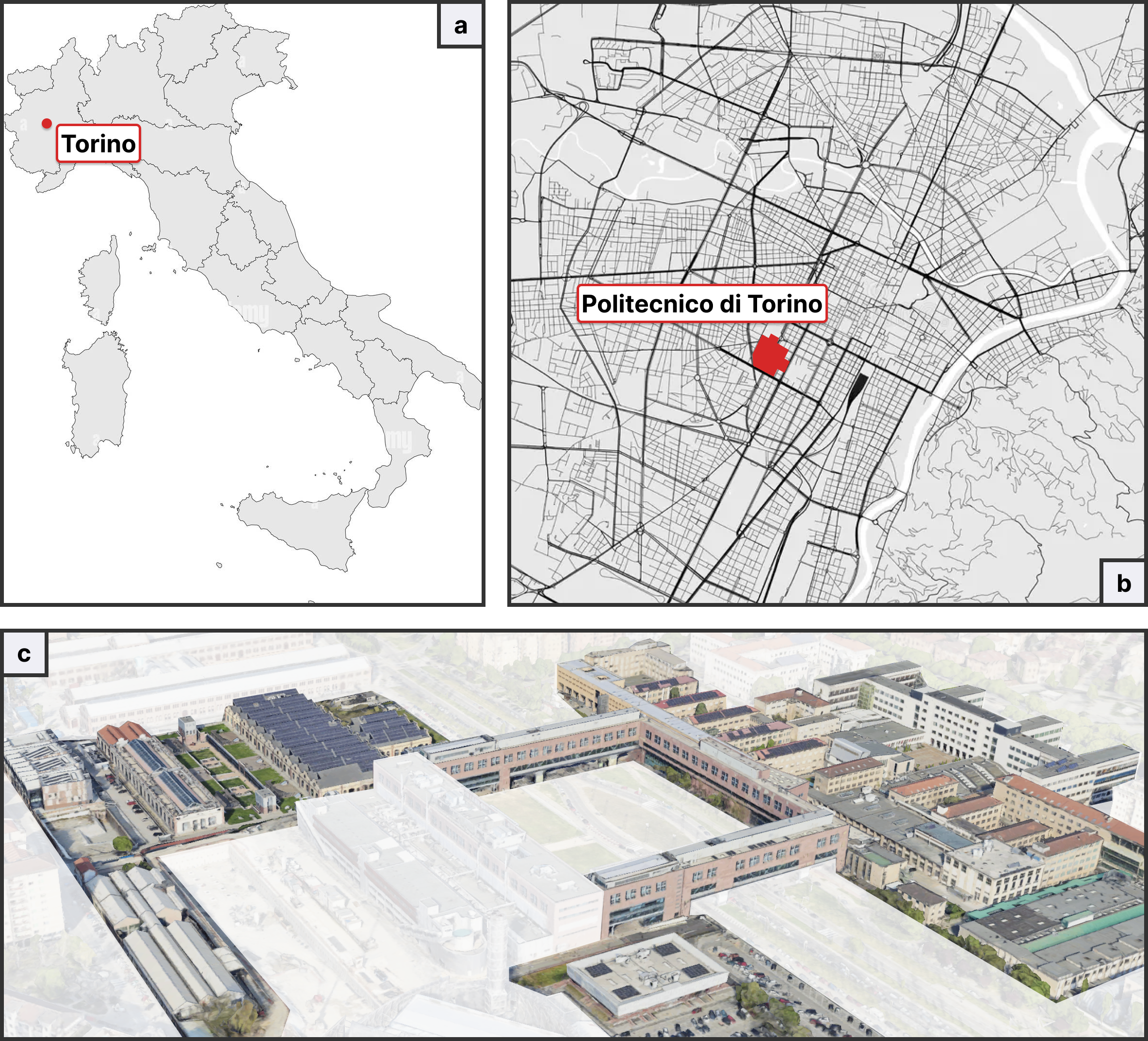
The campus has always been highly monotreded, with a focus on energy efficiency and sustainability. It has been continuously upgraded and modernized in terms of monitoring infrastructure and installation of more efficient energy systems [ref].
Since 2021 more and more efforts have been poured into the modernization of the campus monitoring infrastructure to support facility management and energy management. The goal is to create a transparend, open source and vendor-agnostic solution that can be used as a mean to store and share data among different stakeholders, including maintenance staff, mangement, researchers, and students.
With this aim in mind, the Politecnico di Torino Building Operating System (BOS) was developed.
What is a Building Operating System (BOS)?
The BOS is a comprehensive energy management tool designed to provide a unified platform for collecting, managing, and using building data across the campus. It integrates various building systems, including sensors, Building Automation Systems (BAS), and other measurement devices, to create a cohesive and efficient energy management system. The BOS was designed to be scalable, transparent, and capable of integrating with different building systems, making it a strong reference project for similar large-scale facilities.
From a technical perspective, the BOS is a platform that supports third-party energy applications. It provides:
- Metadata management
- Data storage
- Search capabilities
- Authentication and access control
This structure allows the integration of:
- Proprietary Building Management Systems (BMS)
- Custom data acquisition pipelines
- Various communication protocols
The result is a unified platform for collecting, managing, and using building data.
POLITO BOS Architecture
The proposed BOS is organized into layers:
- Data acquisition layer – Interfaces with physical systems such as sensors, Building Automation Systems (BAS), and other measurement devices. Data is collected via communication protocols and converted into structured models, ensuring quality and consistency.
- Data storage layer – Holds the processed and structured data.
- Data exploitation and application layer – Includes dashboards, analytics tools, automated reports, and visualization platforms along with APIs, enabling applications to access the stored data.
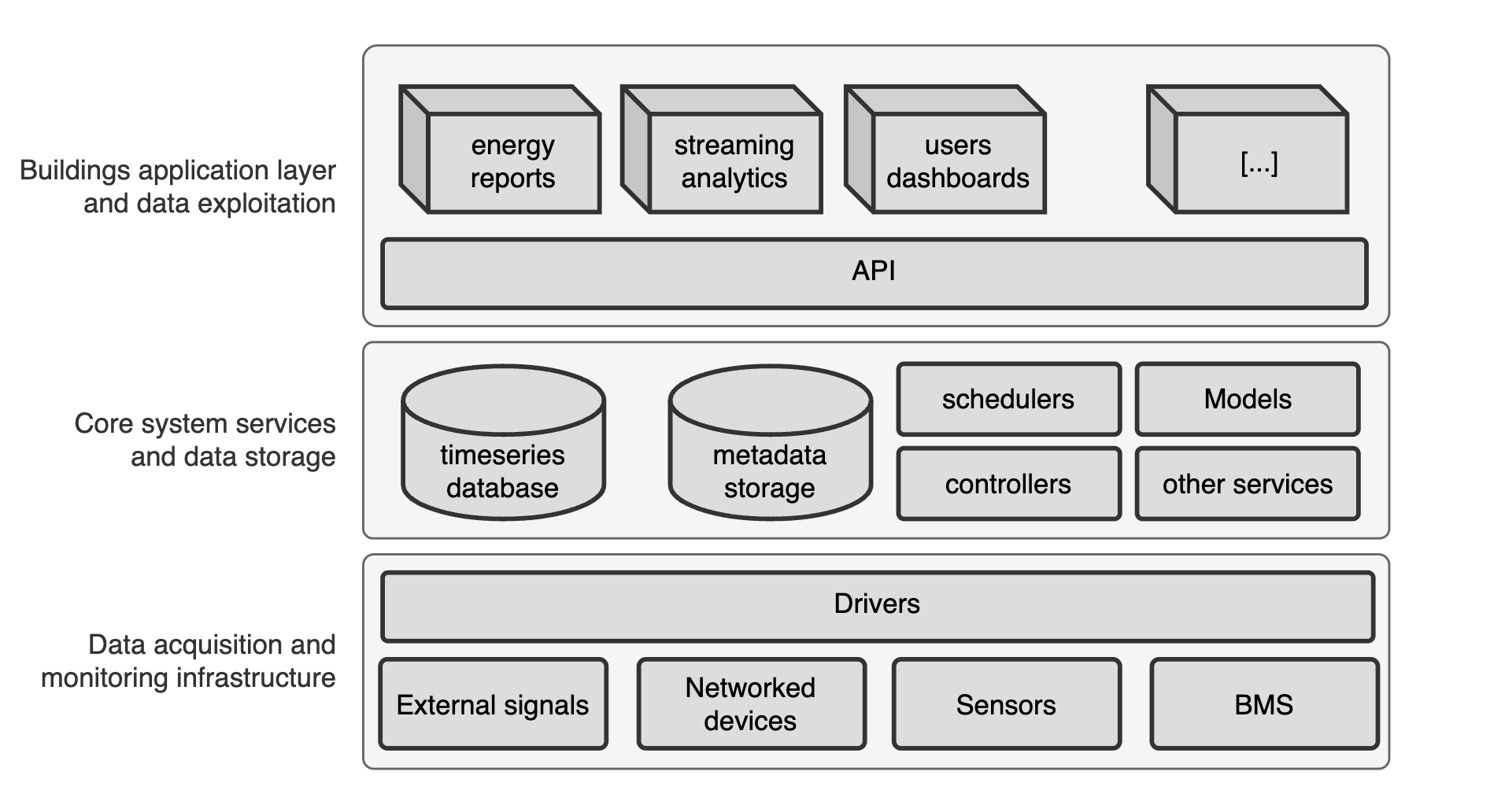
In the following sections, we’ll walk through how this BOS was built for the PoliTo campus, highlighting the design choices, trade-offs, and site-specific constraints that shaped the final implementation.